The real cost of a $100 or $1,000 crypto buy: fee, spread and slippage in one number
One figure for everything a market buy costs: the value you hand over minus the value you hold, at the mid-price. Worked out for five Binance spot pairs on 2026-10-21, split into fee, spread and slippage, with a way to price your own order first.
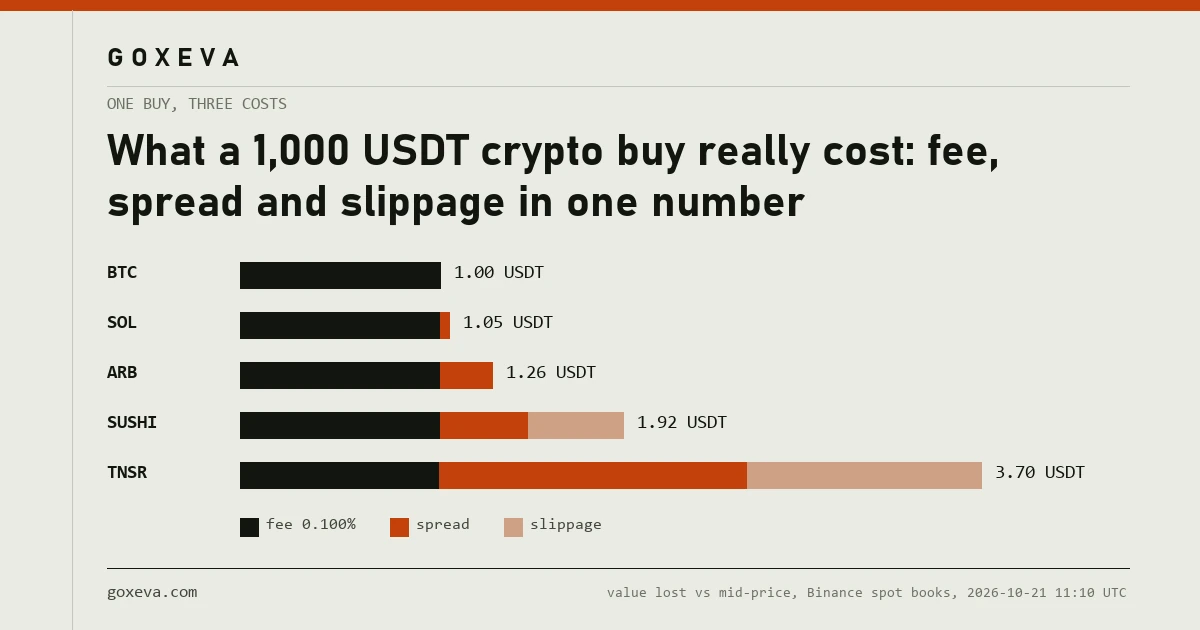
Buy 1,000 USDT of bitcoin on Binance with a market order and you lose about one dollar of value: the 0.100% fee and, at the moment these figures were read, practically nothing else. Spend the same 1,000 USDT on a thinly traded coin and the bill can be close to four dollars, with the fee only a quarter of it. The rest sits in the spread and in slippage, and neither appears anywhere on the order confirmation.
This guide puts all three into one figure: the value you hand over minus the value you hold afterwards, priced at the market mid. Below are that figure and its three parts for 100 and 1,000 USDT buys on five Binance spot pairs, read on 2026-10-21, then one buy worked through level by level, and a quick way to price your own order before you press Buy. Throughout, 1 USDT is counted as 1 US dollar, which is close enough here but not exact.
The one number: what you paid minus what you hold, at the mid
Total cost = amount paid − (coins received after the fee × mid-price). The mid-price is halfway between the best bid and the best ask at the moment you buy. Every cost of a market buy, labelled or not, shows up in that difference.
Why the mid and not the price on the chart? The big number on a trading page is the last trade, which might have been a buyer or a seller. The mid is the fairest single price for what a coin is worth at that instant, and measuring against it lets the three costs be separated cleanly:
- Spread cost = amount × (1 − mid ÷ best ask). You pay the ask, which sits above the mid by half the spread. Every market buy pays this, however small.
- Slippage cost = amount × (mid ÷ best ask − mid ÷ average fill price). This appears only when your order is bigger than what sits at the best ask, so part of it fills at the next, higher levels.
- Fee = coins bought × fee rate, valued at the mid. On Binance spot the fee on a buy comes out of the coin you receive, unless you pay fees in BNB.
Add them and you get the total exactly, not approximately. As a quick estimate in percentages it reads: fee rate + half the spread as a share of the mid + slippage. On a deep pair at the Regular User level the last two round to zero and the estimate collapses to 0.100%.
How much a 100 or 1,000 USDT buy cost on five pairs
The books were downloaded from Binance's public market-data service between 11:09:44 and 11:10:10 UTC on 2026-10-21, one pair after another, using the depth endpoint described in Binance's spot API reference. Anyone can request the same data without an account. Each amount was walked through the ask side level by level, then the 0.100% Regular User taker fee was taken off the coins received.
| Pair | Buy (USDT) | Fee | Spread | Slippage | Total | Total, % |
|---|---|---|---|---|---|---|
| BTC/USDT | 100 | 0.100 | 0.000 | 0.000 | 0.100 | 0.100% |
| BTC/USDT | 1,000 | 1.000 | 0.000 | 0.000 | 1.000 | 0.100% |
| SOL/USDT | 100 | 0.100 | 0.005 | 0.000 | 0.105 | 0.105% |
| SOL/USDT | 1,000 | 1.000 | 0.047 | 0.000 | 1.047 | 0.105% |
| ARB/USDT | 100 | 0.100 | 0.026 | 0.000 | 0.126 | 0.126% |
| ARB/USDT | 1,000 | 1.000 | 0.259 | 0.000 | 1.258 | 0.126% |
| SUSHI/USDT | 100 | 0.100 | 0.044 | 0.000 | 0.144 | 0.144% |
| SUSHI/USDT | 1,000 | 0.999 | 0.441 | 0.477 | 1.917 | 0.192% |
| TNSR/USDT | 100 | 0.100 | 0.154 | 0.000 | 0.254 | 0.254% |
| TNSR/USDT | 1,000 | 0.997 | 1.538 | 1.168 | 3.704 | 0.370% |
Read the table column by column and three things stand out. The fee column barely moves: 0.100% is 0.100%. (It dips to 0.999 and 0.997 on the two thin pairs only because the fee is taken in coins, and those coins were bought above the mid.) The spread column depends on the coin, not on how much you buy. TNSR's best bid and ask were 0.0324 and 0.0325, one price step apart, and one step on a three-cent price is 0.31%, so half of it, about 0.15%, went on every buy. And slippage appears in only two rows, the two where 1,000 USDT was more than the best ask held.
Bitcoin is the boring row and the useful one. The best ask, 83,494.01, carried 11.05 BTC, over 900,000 USDT of coin, against a best bid one cent lower. At that moment the spread cost of a 1,000 USDT buy was a hundredth of a cent. On books like that the fee is effectively the whole bill.
Where the 0.100% comes from
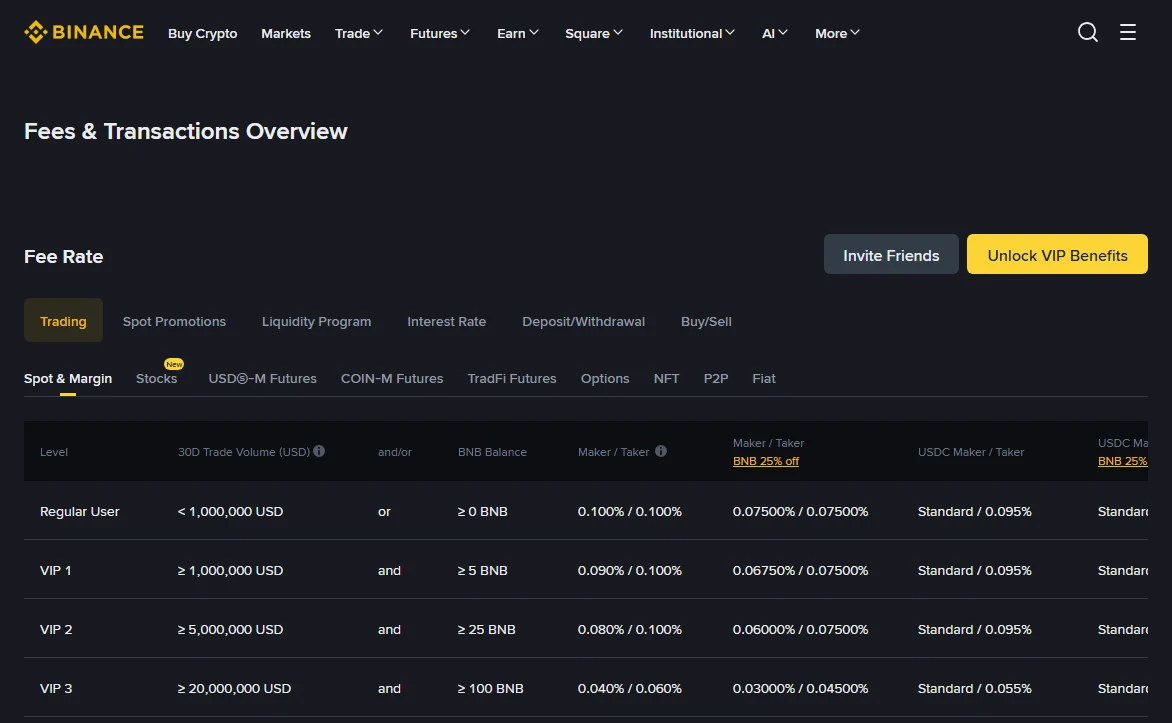
The rate was read from Binance's spot trading fee page on 2026-10-21: Regular User, below 1,000,000 USD of 30-day volume, 0.100% maker and 0.100% taker, or 0.07500% for both with the BNB discount. The same table has a separate column for USDC pairs, showing 0.095% taker for regular users, so a pair quoted in USDC would carry a slightly smaller fee line than the USDT pairs used here.
One buy level by level: 1,000 USDT of SUSHI
SUSHI is the row worth working through, because it carries all three costs. At the snapshot the best bid was 0.2264 and the best ask 0.2266, so the mid was (0.2264 + 0.2266) ÷ 2 = 0.2265 USDT.
- First ask level. 517.5 SUSHI offered at 0.2266, worth 117.27 USDT. All of it is taken; 882.73 USDT still to spend.
- Second level. 3,014.1 SUSHI at 0.2267, worth 683.30 USDT. All taken; 199.44 USDT left.
- Third level. 199.44 ÷ 0.2268 = 879.36 SUSHI, out of 13,248.9 offered. The order is now filled.
- Coins bought. 517.5 + 3,014.1 + 879.36 = 4,410.96 SUSHI, an average price of 1,000 ÷ 4,410.96 = 0.226708.
- Fee. 0.100% of the coins: 4.41 SUSHI. You keep 4,406.55 SUSHI.
- Value at the mid. 4,406.55 × 0.2265 = 998.08 USDT. Total cost: 1,000 − 998.08 = 1.92 USDT, or 0.192%.
Now split that 1.92 with the formulas above. Spread: 1,000 × (1 − 0.2265 ÷ 0.2266) = 0.44 USDT. Slippage: 1,000 × (0.2265 ÷ 0.2266 − 0.2265 ÷ 0.226708) = 0.48 USDT. Fee: 4.41 SUSHI × 0.2265 = 1.00 USDT. Together, 1.92. A 100 USDT buy of the same coin would have stayed inside the first level, so its slippage would have been zero and its total 0.144%.
That jump from 0.144% to 0.192% happened at a definite size. The first level held 117.27 USDT, so any buy up to about that amount paid the best ask and nothing more. Above it, every extra dollar went in at a worse price. How an order sweeps through levels is drawn out in more detail in the guide to market-order slippage.
Price your own buy before you press Buy
You need two minutes and the order book panel on the trading page, which shows the best prices without signing in.
- Read the two prices either side of the gap. The lowest red price is the best ask, and the highest green price under the gap is the best bid. Ignore the large price between them and on the chart: that figure shows the last trade.
- Work out half the spread as a percentage. (ask − bid) ÷ 2 ÷ mid × 100. On TNSR at the snapshot: (0.0325 − 0.0324) ÷ 2 ÷ 0.03245 × 100 = 0.154%.
- Check whether your amount fits in the best ask. The Total column beside each price gives that level's value in the quote coin. If your amount is smaller than the Total on the best ask, slippage is zero. If not, add up the levels you would use, as in the SUSHI example.
- Add your fee rate. 0.100% at Regular User level, 0.075% with the BNB discount switched on. Check your own rate on the fee page, since it changes with VIP level.
The sum is your all-in cost in per cent; multiply by the amount for the figure in money. For deep pairs it will land within a hair of the fee rate, and you can stop doing the exercise for them.
Which of the three you can reduce, and which are not worth chasing
Each cost has a different lever, and the levers have prices of their own.
The fee is paid on every buy, which makes the BNB discount the most dependable saving: it takes 0.100% down to 0.075%. On a 1,000 USDT bitcoin buy that saves 0.25 USDT. It needs a BNB balance and the option turned on, and holding BNB carries its own price risk; the guide to Binance's fee structure covers how the deduction works. For someone making one 100 USDT purchase a month, the saving is 2.5 cents a time, and buying BNB just for that makes little sense.
The spread and slippage disappear if you place a limit order at or below the best bid and wait for a seller to come to you. At the Regular User level the maker fee equals the taker fee, so the limit order saves the spread and slippage but not the fee, and it may never fill if the price moves away. On the TNSR buy above, a filled limit order at the bid would have avoided about 2.71 of the 3.70 USDT. On a thin coin at size, that wait is worth it. On bitcoin, where the spread cost was a hundredth of a cent, waiting for a limit fill saves nothing worth having. The difference between the two order types is covered in the guide to maker and taker fees.
Slippage alone can also be avoided by keeping each market order inside the best ask's Total. Splitting one large order into several small ones only helps if new sellers refill the best level between your orders; send them back to back and you simply walk the same levels in pieces.
If half the spread is smaller than a tenth of your fee rate and your amount fits inside the best ask, the fee is your cost and nothing else needs checking. In the snapshot that held for BTC and SOL. ARB, with half a spread of about 0.026%, was already past it, and SUSHI and TNSR were far past it.
Costs this number leaves out
The total above covers one step: turning USDT into a coin on the order book. Most people pay for other steps on the way in and out, and those can be larger.
- Getting the USDT in the first place. If you buy it with local money through P2P, the price premium over the market rate can outweigh everything in the table. How to read it is in the guide to P2P prices.
- Moving coins off the exchange. Withdrawals carry a network fee that does not scale with the amount, which matters most on small balances; see what sending USDT really costs.
- Using Convert instead of the order book. Convert shows no fee and folds its cost into the quote. The book figures above are the bar a Convert quote has to beat, and the Convert guide shows how to measure one.
- Selling later. The sell side has its own fee, spread and slippage, priced off the bids instead of the asks. A round trip roughly doubles everything in the table.
Doing the same sum on another exchange
The formula does not depend on Binance. On any exchange with a public order book, take the best bid and ask for your pair, walk your amount through the ask levels, and apply that exchange's published taker fee for your account level, read from its own fee page on the day. Fee schedules differ between platforms and change, so carry over the method rather than the 0.100%.
Two things vary from one platform to another. Some take the fee in the quote currency instead of the coin, which moves the fee from the coins column to the money column without changing its size much. And many apps have a simplified buy screen, separate from the order book, that prices the trade differently; measure that one against the mid exactly as you would a Convert quote.
Next step: to turn your own fee rate and amount into money, and to see how far the price must rise before a buy and a later sell break even, use the trading fee calculator. Add the half-spread from step 2 above to its fee figure and you have the whole cost of the buy.