Perpetual futures funding rate: what it costs to hold overnight
Funding is charged against the size of your position, not against the money you put up, which is why a rate that looks like a rounding error can be a serious drag on a leveraged trade. Here is the arithmetic, and the honest verdict on how much it should change what you do.
Short version. Funding is charged against your position notional and never against the margin you posted, so leverage multiplies it against the money you actually put up. The same 0.01% rate is 0.01% of notional and 0.20% of your own capital at 20×, every eight hours.
This is for anyone carrying a perpetual past a settlement stamp. If you are flat by the evening it barely touches you, and the round-trip trading fee is the cost worth your attention instead.
What is a funding rate?
A funding rate is a periodic payment made directly between the holders of long and short positions in a perpetual contract, sized as a percentage of each position's notional value, that pushes the contract's price back toward the price of the underlying asset.
Two features of that definition are load-bearing. First, it is a payment between traders. The exchange is the plumbing, not the recipient. If the rate is positive, longs pay shorts; if negative, shorts pay longs. On a well-run venue nobody takes a cut in the middle, which is why funding does not appear alongside maker and taker fees on the fee schedule. It is not a transaction fee.
Most people meet it by accident. You open a position, you watch price, and at some point you notice the balance is a little lower than the profit and loss column says it should be. Nothing was closed. Nothing was liquidated. A small amount simply left.
In the account it shows up as its own line. Funding settlements are recorded separately from realised profit and loss and separately from trading fees, usually in a transaction history that has to be filtered to be readable — the type dropdown defaults to showing everything at once, and funding is one row type among a dozen. This is the mechanical reason funding gets missed. It never appears inside the profit and loss figure you are watching on the position, so the position looks like it is doing one thing while the balance quietly does another, and the two only reconcile if you go and find the third list. If you have held perpetuals for a while and never opened that view, it is a short and slightly uncomfortable exercise.
Second, it is sized on notional. Not on your margin, not on your unrealised result, not on your account balance. The full face value of the contract you are holding. That single fact is most of this page.
Binance sets out the mechanism and the formula in its introduction to futures funding rates, and the historical rate for every contract is published on its funding history page. Both are worth opening before you take a position you intend to hold. The second one in particular tells you whether the contract has been cheap or expensive to carry recently, which is information you can have for free and most people do not look at.
A perpetual has no expiry to keep it honest
A perpetual has no expiry date, so it has no settlement event to force its price back into line with spot, and funding is the substitute mechanism that tethers the two.
A traditional futures contract expires. On expiry it settles against the spot price, and that certainty does the work: as the date approaches, any gap between the futures price and spot becomes an arbitrage with a known deadline, and the gap closes. The whole structure of contango and backwardation, set out in Binance Academy's note on forward and futures contracts, depends on there being a date at which the two prices must meet.
A perpetual removes the date. That is the product's entire appeal. You get leveraged exposure that you never have to roll, no expiry calendar, no quarterly scramble to move a position from one contract to the next.
But remove the expiry and you remove the thing that kept the price honest. Nothing stops a perpetual trading 5% above spot indefinitely, because there is no moment at which the two are forced to agree. So the mechanism has to be built in rather than inherited, and funding is that mechanism: a continuous, recurring cost imposed on whichever side is pushing the contract away from the index, and a continuous payment to whoever is willing to take the other side.
The economics are simple once you see them that way. If the perpetual trades above spot, longs pay. Paying to hold a long makes holding a long less attractive, and being paid to hold a short makes shorting more attractive, so the imbalance is taxed until it goes away. It is a price on crowding.
Which means funding is not really a fee at all. It is the rent charged for standing on the popular side of a market that has no expiry to sort it out.
Notional is the base, not the margin you posted
On your position notional, always, which means that at 20× leverage a funding rate measured against the position is twenty times larger measured against the money you actually posted.
This is the single most useful thing to understand about funding, and it is the thing the number on screen actively hides. The rate is quoted as a percentage of notional. Your mental accounting is in units of margin. Those two are separated by exactly your leverage multiple.
Take a position with 10,000 USDT of notional and a funding rate of 0.01% for the interval. The payment is 10,000 × 0.0001 = 1.00 USDT. That is the same 1.00 USDT regardless of your leverage, because leverage does not change the notional. What leverage changes is the denominator you are comparing it against.
| Leverage | Margin posted | Funding per settlement | Cost vs notional | Cost vs margin |
|---|---|---|---|---|
| 1× | 10,000.00 | 1.00 | 0.01% | 0.01% |
| 3× | 3,333.33 | 1.00 | 0.01% | 0.03% |
| 5× | 2,000.00 | 1.00 | 0.01% | 0.05% |
| 10× | 1,000.00 | 1.00 | 0.01% | 0.10% |
| 20× | 500.00 | 1.00 | 0.01% | 0.20% |
| 50× | 200.00 | 1.00 | 0.01% | 0.50% |
The fourth column never moves. The fifth column is the one you feel. At fifty times leverage, a rate that reads as a hundredth of a percent is taking half a percent of your posted capital every time it settles, and it will settle again in eight hours.
Write it as a rule and it fits on one line:
Funding cost as a fraction of your margin = funding rate × leverage.
That is all. The rate you read on screen, multiplied by the leverage you selected. A trader at 3× and a trader at 50× looking at the same 0.01% on the same screen are looking at two costs that differ by a factor of about seventeen, and neither number is displayed.
The funding figure in the interface is quoted against notional because that is how the contract defines it, and there is nothing misleading about that. But nobody sizes their thinking in notional. Before you hold anything overnight, do the multiplication once: rate times leverage. It takes five seconds and it is the difference between "negligible" and "this position needs to move a full percent a day just to stand still".
How often is funding actually charged?
Most major perpetual contracts settle funding every eight hours, three times a day, though the interval is set per contract and some venues shorten it during extreme volatility, so the contract's own specification page is the authority.
The common arrangement, and the one Binance documents as its default, is settlement at 00:00, 08:00 and 16:00 UTC. Three payments a day. Some contracts run on four-hour or one-hour intervals instead, and Binance's own documentation notes that intervals can be shortened when a market is moving violently. This is not a constant you should carry in your head across venues or across contracts. Open the contract page and read it.
The mechanical rule that follows is worth stating plainly, because it surprises people in both directions:
You pay funding only if you are holding the position at the settlement stamp. Not before, not proportionally, not for time held.
Open a position at 08:05 and close it at 15:55 and you have held for nearly eight hours and paid nothing. Open at 15:59 and close at 16:01 and you have held for two minutes and paid the full interval. Funding is a snapshot, not a meter. There is no pro-rating.
This produces some visible behaviour around the stamps. Positions get closed in the minutes before settlement and reopened after. On contracts where the rate has gone strongly one way, that flow is large enough to see in the order book. Whether it is worth doing for your own position is arithmetic, and usually the answer is no, because two trading fees plus two crossings of the spread cost more than one ordinary funding payment. At an unusual rate the answer flips. Do the sum rather than assuming.
There is also a cap. Venues bound the funding rate per interval so that a dislocated market cannot produce an unbounded payment, and the cap is set per contract alongside the interval. Like the interval, look it up rather than assuming a number.
What does it mean when funding goes negative?
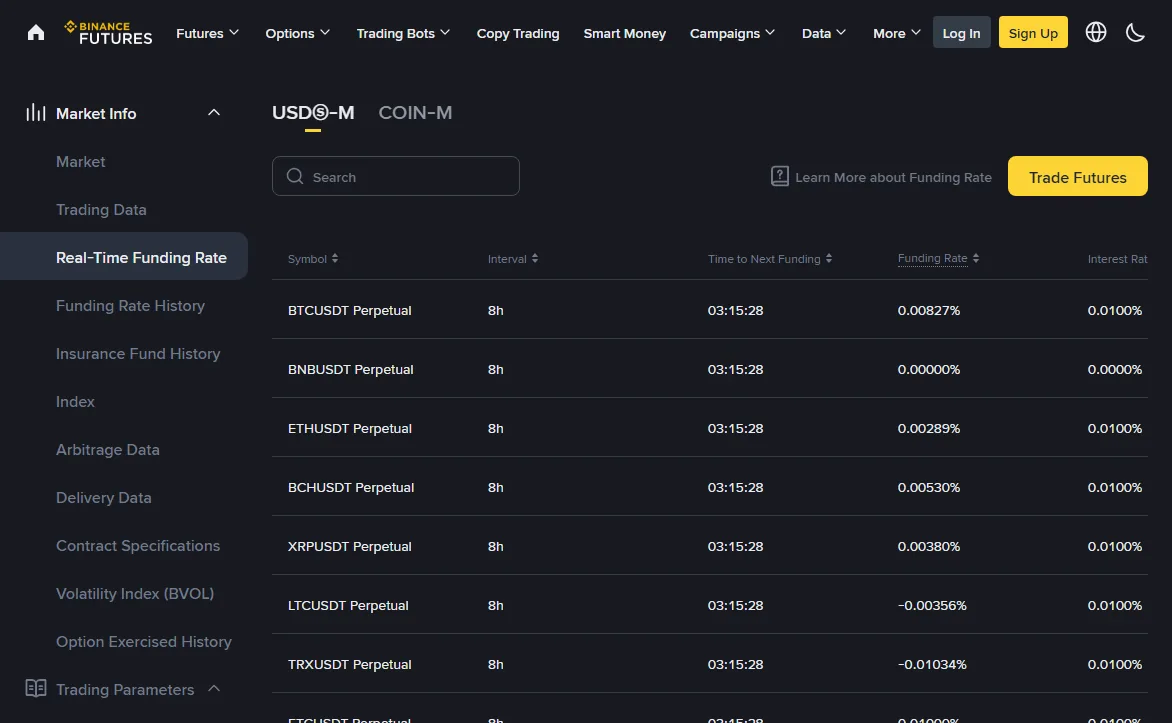
Negative funding means the perpetual is trading below the index price, so the payment reverses and short positions pay long positions for as long as it stays that way.
The sign convention is straightforward once you attach it to the price relationship rather than trying to memorise it.
| Rate | Perpetual vs index | Who pays | What it says about positioning |
|---|---|---|---|
| Positive | Trading above | Longs pay shorts | Leveraged demand is on the long side |
| Negative | Trading below | Shorts pay longs | Leveraged demand is on the short side |
| Near zero | Close to index | Small transfers either way | Neither side is paying up for exposure |
A single negative print is noise. What carries information is persistence. When funding stays negative on a major contract across many consecutive settlements, it means shorts have been continuously paying to keep the position on, and they have kept paying anyway. That is a statement about conviction and crowding on the short side, and about the absence of enough long demand to close the discount.
What it is not is a signal. The temptation, and I have felt it, is to read persistently negative funding as a contrarian buy: everyone is short, they are paying to be short, therefore the squeeze is coming. Sometimes that is exactly what happens. Sometimes funding stays negative for weeks while price grinds lower, and the people who were being paid to hold longs lose far more on the position than they collected in funding. Positioning tells you where the crowd is standing. It does not tell you whether the crowd is wrong.
The one solid use is arithmetic rather than predictive. If you were going to hold a position in the direction that is being paid, then being paid to hold it genuinely improves the trade. Persistent one-sided funding is also what makes the various carry structures possible, the ones that pair a perpetual short against spot to collect the rate. Those trades have their own risks, none of them small, and a hedge that has to be maintained across two products is not the free money it looks like on a spreadsheet.
Two components behind one rate
The rate is built from two pieces: a fixed interest-rate component that reflects the cost of holding the two currencies in the pair, and a premium component that measures how far the perpetual has drifted from the index.
The interest component is the boring half. It is a fixed baseline, applied every interval, standing in for the difference in carrying cost between the quote currency and the base asset. Binance documents its default as 0.03% per day, which works out at 0.01% per eight-hour interval, and that figure is checked against their published documentation in 2026-08. Some contracts use a different baseline. It rarely changes and it is rarely the interesting part.
The premium component is where the movement lives. It is derived from a premium index that tracks how far the perpetual's traded price sits from the underlying index price, sampled repeatedly through the interval rather than read once at the end. If the contract has been trading persistently above the index, the premium is positive and pushes the rate up. If it has been trading below, the premium drags the rate down and eventually negative.
The two are combined with a dampener, so that small deviations from the index do not move the funding rate at all and the rate sits at its interest baseline during calm conditions. That is why a quiet market shows the same small positive number interval after interval: nothing is happening in the premium term, and you are seeing the baseline on its own.
The practical reading is that a funding rate near the baseline tells you nothing except that the market is calm, and a funding rate several multiples of the baseline tells you the premium term has taken over and one side is paying up for exposure. The gap between the two is the signal about positioning, not the absolute level.
The bill after a day, a week and a month
At an ordinary 0.01% per eight hours a position costs about 0.03% of notional per day, but against margin at 20× leverage that is 0.6% per day, which is 18% of the posted margin over a month.
Funding accumulates linearly against the position, three payments a day, indefinitely. There is no point at which it stops. The table below takes a 10,000 notional position at 20× leverage, so 500 of margin, and runs it forward at two rates: an ordinary one and an elevated one that a trending contract can hold for extended stretches.
| Held for | Settlements | Cost at 0.01% | % of 500 margin | Cost at 0.05% | % of 500 margin |
|---|---|---|---|---|---|
| 1 day | 3 | 3.00 | 0.60% | 15.00 | 3.00% |
| 3 days | 9 | 9.00 | 1.80% | 45.00 | 9.00% |
| 1 week | 21 | 21.00 | 4.20% | 105.00 | 21.00% |
| 2 weeks | 42 | 42.00 | 8.40% | 210.00 | 42.00% |
| 30 days | 90 | 90.00 | 18.00% | 450.00 | 90.00% |
Look at the bottom right cell. At an elevated but entirely ordinary rate, a month of holding a 20× position on the paying side costs almost the whole posted margin. The position does not need to be wrong. It only needs to go nowhere.
Annualised, 0.01% per interval is about 10.95% of notional a year, and 0.05% is about 54.75%. Those are the figures against notional. Multiply by leverage for the figure against your money, and the second number stops being a financing cost and becomes the dominant term in the trade.
There is a compounding effect on top of the linear one, and it works through margin rather than through the payment. Funding is deducted from your balance, which reduces the equity backing the position, which pushes the liquidation price closer. Carry a position at high leverage through a long stretch of adverse funding and it will liquidate on a smaller adverse move than it would have on day one, purely because the collateral has been eroding the whole time. The liquidation price arithmetic is the same as ever; the margin term in it has been shrinking. Under cross margin this is easy not to notice, because there is no single ring-fenced number visibly going down.
A swing position held for three weeks pays roughly sixty-three funding settlements. If you sized the trade on entry and never revisited the carrying cost, you have made a decision about sixty-three payments you never explicitly priced. Work out the cost of the intended holding period before you open, not after, and write it next to the target so the two are visible together.
Is funding bigger than the trading fee?
For a position held less than a day, no, the round-trip trading fee dominates; past roughly a week at an ordinary rate, funding has overtaken it and keeps going.
These two costs are worth putting side by side because they behave completely differently. The trading fee is a one-off charged twice, once entering and once leaving, and it does not care how long you hold. Funding is a recurring charge that does not care how many times you trade. Whichever is larger depends entirely on holding period, and the crossover is closer than people assume.
Checked against Binance's own public fee page on 2026-08-30, an ordinary account with no volume history pays 0.100% as both maker and taker on spot, dropping to 0.07500% with the 25% BNB discount applied. Futures schedules are lower than spot but the shape of the comparison is the same, so the spot numbers are used here as a clean illustration rather than as the futures rate for your account. Read your own tier off the exchange's live page.
| Cost on 10,000 notional | Amount | % of notional | Settlements to match it at 0.01% | Roughly how long |
|---|---|---|---|---|
| Round trip at 0.100% each side | 20.00 | 0.200% | 20 | 6.7 days |
| Round trip at 0.07500% each side | 15.00 | 0.150% | 15 | 5.0 days |
| One funding settlement at 0.01% | 1.00 | 0.010% | 1 | 8 hours |
| One funding settlement at 0.05% | 5.00 | 0.050% | — | 8 hours |
At an elevated 0.05% the crossover collapses. Four settlements, a little over a day, and funding has already cost more than the entire round trip. A week at that rate costs seven times the trading fee.
The practical conclusion is about which cost deserves your attention at which horizon. For intraday trading, fee tier and order type are the levers that matter and funding is close to irrelevant. For anything held past a couple of days, the ordering reverses, and a trader carefully choosing post-only entries to save a fraction of a basis point while sitting on the paying side of an expensive contract for a fortnight has the priorities backwards.
Three levers, and only three
There are only three levers: hold less notional, hold it for fewer settlements, or hold it on the side that is being paid rather than the side that is paying. They are worth going through in order, because two of them are usually available and the third rarely is.
- Less notional. Funding scales with position size, so halving the size halves the cost in absolute terms. Note carefully that this does nothing to the cost as a percentage of your margin if you keep the same leverage, because you have halved both the numerator and the denominator. Reducing the cost relative to your capital means reducing leverage, not just size.
- Fewer settlements. Being flat across the stamp costs nothing. For a thesis that is going to take three weeks to resolve, this is not usable. For a position you would have closed by evening anyway, closing before the stamp rather than after is a small free saving.
- Check the sign before you open. If funding on the contract has been strongly one-sided for days, the historical rate page will show it, and the direction you were planning to take may already be the expensive one. That does not make the trade wrong. It makes it a trade that has to clear a hurdle you can measure in advance.
What does not work is treating funding as a reason to switch direction. Taking the paid side of a contract you have no view on is not a strategy; it is accepting a small, capped inflow in exchange for uncapped directional exposure. If you want the funding without the direction you need a hedge, and then you are running a two-legged position with its own margin requirements, its own basis risk, and its own way of going wrong at exactly the wrong moment.
The funding cost projector on this site takes a rate, a notional and a number of hours and shows the total against margin, which is the version of the number you actually want.
Does funding actually matter, or is this overthinking?
Funding is almost always small next to the cost of being wrong about direction, and it is almost always the thing that decides whether a slow, correct idea was worth carrying.
Both halves of that are true and neither cancels the other.
If a position moves 8% against you, no funding rate you will meet in ordinary conditions comes close to mattering. Direction dominates. Someone who obsesses over a 0.01% settlement while running fifty times leverage on a market they have not thought about has optimised the wrong variable by a wide margin, and the sequencing should be direction first, size second, funding third.
But the trades funding decides are not the ones that go 8% against you. They are the ones that are eventually right. The thesis that needed three weeks and got there in four. The range trade that worked but paid for six days of waiting first. The hedge that was sound but was carried on the expensive side. In every one of those the direction call was fine, and the arithmetic of carrying it is what turned a modest gain into nothing, or into a loss.
So the useful posture is neither ignoring funding nor building a strategy around it. Price the intended holding period before you open. Multiply by leverage so the number is in the units you actually think in. And if the answer is that carrying the position for the time you expect it to need costs a meaningful share of what you stand to make when it works, that is not an argument for a different funding rate. It is an argument for a smaller position, or for a longer instrument, or for the trade being one you were only going to enjoy in a market that moved faster than this one is moving.
Does the exchange keep my funding payment?
No. Funding is a transfer between traders. The side that pays sends it to the side that receives, and on a well-run venue the exchange takes no cut of it. That is why funding is not listed with the maker and taker fees: it is not a fee on a transaction, it is a periodic settlement between two open positions. You still pay ordinary trading fees separately when you open and close.
Can I avoid funding by closing before the settlement time?
Yes, in the narrow sense that funding is charged only on positions open at the settlement stamp. If you are flat when the stamp passes, you pay nothing and receive nothing, no matter how long you held during the interval. Whether that is worth doing is a separate question, because closing and reopening costs two trading fees plus spread, and that round trip is usually more expensive than one funding payment at an ordinary rate.
What does a persistently negative funding rate tell me?
That the perpetual has been trading below the index and short positions have been paying longs to keep it there, which is a statement about crowding rather than about direction. Persistent negative funding says the market is willing to pay to be short. It is positioning information, not a signal, and reading it as a contrarian buy indicator is a well-populated way to lose money.
How do I work out my own funding cost before I open?
Multiply the position notional by the current rate to get one settlement, multiply by the number of settlements you expect to sit through, and then divide that total by the margin you posted rather than by the notional. The last division is the step people skip, and it is the one that turns an abstract fraction of a percent into a number you can compare against the move you are hoping for.