What moving USDT actually costs you
A withdrawal fee is one line on one screen, and it is not the whole bill. This piece takes the cost of moving USDT apart layer by layer and works out the transfer size below which sending stops making sense.
Where the money actually goes. The cost of moving USDT is a stack, not a line: the exchange's flat withdrawal fee, the network cost underneath it, anything the receiving side charges, the spread on any conversion you make along the way, and the dust you never bother to move. On a flat fee of around 1 USDT the first of those swamps the rest below about 100 USDT: 100 gives up 1%, 20 gives up 5%, 10 gives up 10%. Somewhere between 300 and 400 the conversion spread takes over as the largest line and never gives the lead back.
Useful if you send small or awkward amounts and want to know where the floor is. Not useful if your transfers are consistently in four figures, where the fee is already background noise.
Most people stop thinking about this after the first few transfers. Then someone sends 30 USDT to a friend, the friend receives 29, and roughly three per cent of the money has gone into a charge that would have been invisible on a 3,000 USDT send. Several separate parties can take something out of a transfer before it lands. Some of them show you a number. Some do not.
The five layers of a USDT transfer
A single USDT transfer can carry up to five distinct costs: the exchange's flat withdrawal fee, the underlying network fee, anything the receiving platform charges, the spread on any conversion you do on the way, and the money you leave stranded because the remainder was too small to be worth sending.
It helps to think of a transfer as a route rather than an event. Money leaves a balance somewhere, gets written onto a public ledger, gets read off that ledger by someone else, and usually changes form at least once. Each handoff has a price, and the prices are quoted in completely different ways. One is a flat number of tokens. One is a percentage. One is not quoted at all, and shows up only as a gap between the price you were given and the price the market was at.
Laid out in the order you meet them:
- The exchange withdrawal fee. A fixed amount per withdrawal, chosen by the platform, different for every network, deducted from what you send.
- The network fee. The real cost of getting the transaction included in a block. On a withdrawal from an exchange you never see it directly. Sending from your own wallet, you pay it yourself in the chain's native token.
- Anything the receiver charges. Usually nothing for a crypto deposit, but minimum-deposit thresholds and unsupported networks can cost you the entire amount rather than a percentage of it.
- Conversion. Any point where USDT becomes something else, or something else becomes USDT, has a price attached even when no fee line is displayed.
- The dust you never move. Balances left behind because sending them would cost more than they are worth. This one is real and almost nobody counts it.
The withdrawal fee is the exchange's price, not the chain's
The withdrawal fee is set by the exchange rather than by the blockchain: it is a fixed per-withdrawal charge the platform chooses for each network it supports, and it is deducted from the amount you send rather than added on top of it.
This is the single most misread line in the whole process. People assume the number next to "network fee" on the withdrawal screen is what the chain is charging, passed through at cost. It is not. It is the exchange's own price for performing a withdrawal on that network, and the exchange is free to set it wherever it likes. Some platforms price it close to their actual cost. Some price it well above. Some run promotions where a particular network is temporarily free.
Two properties follow from that, and both matter more than the size of the fee itself.
It does not scale with the amount. Sending 10 USDT and sending 10,000 USDT cost the same. The chain does not care how many zeroes are in the value field, and neither does the exchange's pricing. This is why the fee is nearly irrelevant on large transfers and brutal on small ones, and it is the reason the minimum viable size section further down exists at all.
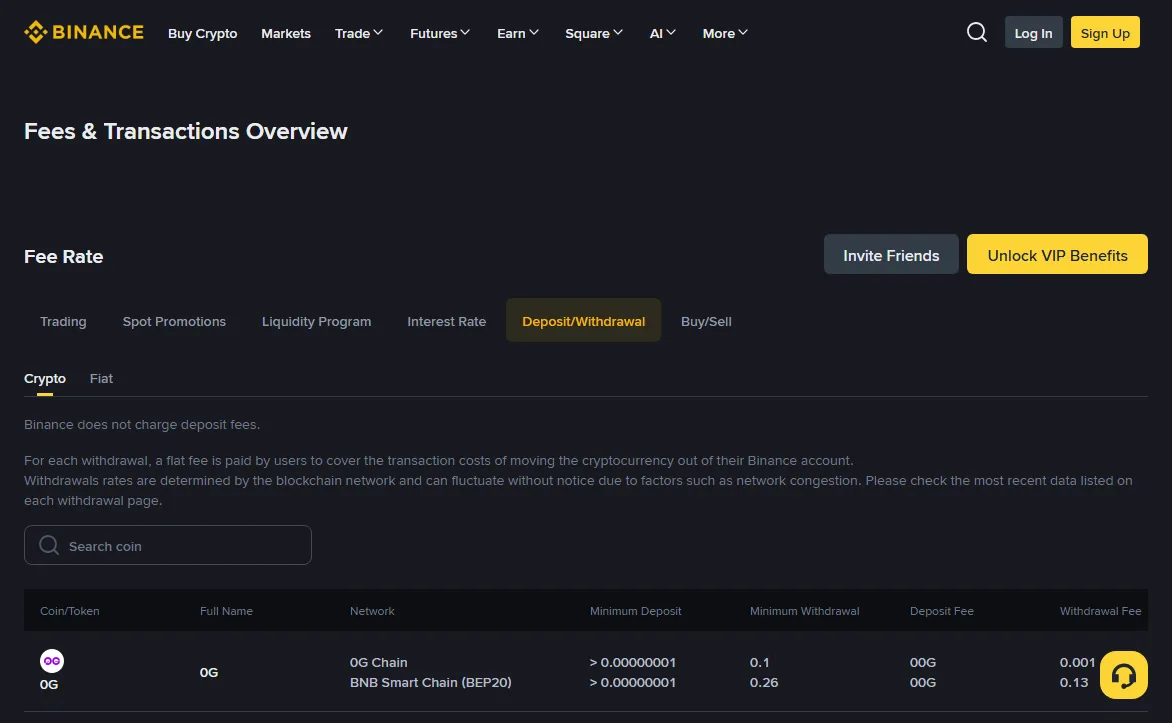
It differs sharply by network. The same USDT, in the same account, withdraws at completely different prices depending on which entry in the network dropdown you pick. As of 2026-08, checked against Binance's own crypto withdrawal fee page, the shape is roughly this: USDT on Tron sits at a low flat fee of around 1 USDT; on Ethereum it is several times that and moves with gas conditions; on BSC it typically sits well below the Tron figure. Treat all three as ranges. They are changed by the exchange whenever it wants to, sometimes weekly, and the figure on your withdrawal screen at the moment you confirm is the one that governs.
The fee is charged in the token you are withdrawing. Withdraw USDT and the fee is denominated in USDT, so a 1 USDT fee is a 1 USDT fee regardless of what ETH or TRX is doing that day. That is convenient for arithmetic and slightly misleading, because it hides the fact that the exchange's real cost underneath is denominated in something volatile.
Why flat rather than proportional? Because the exchange's own cost is flat. It pays a chain fee per transaction, not per dollar. A flat fee matches that cost structure and, incidentally, discourages the thing exchanges least want, which is thousands of tiny withdrawals clogging the hot wallet queue.
One more thing about how these fees are set. Because the underlying gas cost is volatile and the posted fee is not updated continuously, the exchange is running a rolling estimate with a buffer built in. When the network is quiet you pay more than the transaction cost. When it is congested you may pay less. Over any reasonable period the buffer wins, which is what you would expect from a business.
Who actually pays the blockchain fee?
When you withdraw from an exchange, the exchange pays the chain out of its own native-token reserves and recovers that cost through its flat fee; when you send from your own wallet, you pay the chain directly and you must hold the network's native token to do it.
These are two genuinely different situations, and conflating them causes a specific, common, entirely avoidable failure.
On the exchange side, the mechanics are hidden. The platform holds USDT in pooled hot wallets, holds ETH, TRX and BNB to pay for outbound transactions, signs and broadcasts the transfer, and debits your ledger balance by the amount plus its flat fee. You never touch the native token. You never see a gas price. From your side it is one number.
On the self-custody side, nothing is hidden and nothing is bundled. USDT is a token contract that sits on top of a chain, and moving a token still requires paying the chain in its own currency:
- Ethereum. Fees are paid in ETH, computed as gas used times gas price, with a base fee that rises and falls with demand and a priority tip on top. The gas documentation on ethereum.org sets out the mechanism. Slots come roughly every 12 seconds, so inclusion is fast once you have paid enough; the variable is price, not time. A live figure is easiest to read off a public gas tracker such as the one on Etherscan.
- Tron. Fees are paid in TRX, but through a resource model of bandwidth and energy rather than a straight per-transaction price. Users can stake TRX to obtain those resources instead of burning it. Blocks come about every three seconds. The Tron project site is the starting point for the resource model, which is genuinely different from the gas model and catches people out the first time.
- BSC. Fees are paid in BNB and have historically been small in absolute terms, which is most of why the network exists in this conversation at all.
Now the failure. A wallet holding 500 USDT on Ethereum and zero ETH cannot send anything. Not a smaller amount, not a partial amount, nothing. The token cannot pay for its own movement. People withdraw USDT to a fresh self-custody address, see the balance arrive, then discover they need to acquire ETH from somewhere and get it into that same address before the USDT is usable. If the amount is small, the ETH you need to buy may itself cost more than the USDT is worth.
If you are withdrawing to a wallet you control and intend to move the funds onward later, send a small amount of the network's native token to that address in the same session. It costs a second withdrawal fee, and it prevents the situation where a balance is visible, yours, and completely immobile.
The exchange's flat fee and the true chain cost drift apart constantly, and by different amounts on different networks. You cannot see which way the gap runs from the outside, and it does not change the decision. Pick a network the recipient can actually receive on, then pick the cheapest of the survivors. The compatibility side of that choice is covered in the piece on choosing a transfer network.
Does the receiving side charge anything?
Most exchanges credit an incoming crypto deposit with no fee at all, but the receiving side can still cost you through minimum-deposit thresholds, unsupported networks, missing memos and whatever it charges when you eventually take the money out again.
Take the good news first. Depositing crypto into a major exchange is normally free. The platform is not going to charge you for bringing it assets. There is no line item, no percentage, and the amount that hits your balance is the amount that arrived on chain.
The costs on this side are structural rather than itemised, and they are lumpier. Instead of losing a percentage, you lose everything or nothing.
Minimum deposit amounts. Many platforms set a floor below which an incoming transfer will not be credited automatically. Send less than that and the funds are not lost in the sense of being gone from the chain, but they may sit unassigned until someone processes them manually, and manual recovery may involve a request, a wait, and in some cases a charge. The floor is usually published on the same screen that gives you the deposit address. Read it before you send a test transaction, because a test transaction is exactly the kind of small amount that trips it.
Network mismatch. An address that looks valid for one chain can look valid for another. Sending a token over a network the receiving platform does not credit for that token is the single most expensive mistake available here, because the amount at risk is the whole transfer rather than a fee. Whether anything is recoverable depends on who controls the destination address and on the specific chains involved. That case is worked through in the piece on deposits that have not arrived.
Memos and tags. Some chains identify the recipient inside a shared address using a memo or destination tag. Omit it and the transfer lands in a pooled account with nothing pointing it at you. Again, not a fee, but a potential total loss followed by a support ticket.
Confirmation thresholds. Not a cost in money, but a cost in time and certainty. Every platform sets its own number of confirmations before a deposit is credited, and the number varies by asset and by network. It is published on the deposit page. It changes. If your transfer is time-sensitive, look it up rather than assuming.
The item people forget entirely is the exit. A free deposit does not make the round trip free. Whatever you put in has to come out again eventually, and the way out is usually the most expensive step in the entire chain: a bank withdrawal fee, a card payout charge, a peer-to-peer spread, or another crypto withdrawal fee at the far end. If you are comparing two routes, compare them all the way to the currency you actually want to end up holding, not to the point where the balance appears somewhere.
Every conversion has a price, even with no fee line
Every conversion costs something even when no fee is displayed, because the price you are quoted sits some distance from the mid-market price, and on any meaningful amount that distance is usually larger than the withdrawal fee you were worrying about.
A spread is the gap between the best price someone will buy at and the best price someone will sell at. The midpoint between them is the closest thing to a fair price at that instant, and any quote you accept sits on one side of it. Investopedia's definition of the bid-ask spread is the short version if the term is new.
Three things make this the most underestimated cost in the stack.
First, it is invisible. A withdrawal fee comes with a number and a ticker next to it. A spread is shown as a price, and unless you have the market in another tab you have nothing to compare it against. People optimise whatever is labelled.
Second, it scales with the amount, which is the opposite of the withdrawal fee. The bigger the transfer, the less the flat fee matters and the more the spread does. These two costs cross over, and the crossover point is lower than most people guess.
Third, stablecoins are not exempt. USDT against USDC does not trade at exactly 1.0000, and a one-click conversion between two dollar stablecoins can still cost tens of basis points. Two things that are both "a dollar" can still be priced a quarter of a per cent apart, and if you are round-tripping between them you pay it twice.
The practical difference is easiest to see with a number. On a 2,000 USDT conversion, a quote sitting 0.30% away from the mid costs 6 USDT. On the same amount, a limit order placed on a liquid book at a maker rate of 0.100% costs 2 USDT, and if the order rests rather than crossing, you are not paying half the spread on top. The withdrawal fee in the same journey is around 1 USDT. The conversion is the biggest line, and it is the only one with no label.
How to check a quote before accepting it: open the spot pair for the two assets, read the best bid and the best ask, take the midpoint, and compare that against what the conversion screen is offering. Express the difference as a percentage of the amount. Anything under about a tenth of a per cent on a deep pair is fine. Anything approaching half a per cent is a market order on a thin book with a margin attached, and on a large amount you should place the order yourself. The mechanics of that comparison, on one specific product, are in the fee breakdown's section on Convert versus the order book.
Are transfers between accounts on the same exchange free?
Yes, in the ordinary case: moving USDT between your own wallets inside one exchange, or sending it to another user of that same exchange by email address or account ID, is a database entry rather than a blockchain transaction, so there is no network fee and normally no charge at all.
Two separate things are free here. The first is moving your own balance between the compartments of your own account: spot to funding, funding to futures, and so on. Nothing leaves the exchange. Nothing touches a chain. The balance is decremented in one column and incremented in another, instantly, at no cost. If your USDT is in the wrong wallet for what you want to do, that is an inconvenience, not an expense.
The second is sending to another person who holds an account at the same exchange. Most large platforms support a direct internal transfer by email, phone number or user ID. It settles immediately, there is no address to mistype, there is no network to select, and there is nothing to pay. For a 25 USDT payment to a friend, this is the difference between losing four per cent and losing nothing.
Some honest caveats, because "free and instant" always has a shape to it.
- Both sides have to be on the same platform. This is a genuine constraint and not something you can talk your way around.
- There is no transaction hash and no explorer record. If you want independent, verifiable proof that a payment happened, an internal transfer does not give you one.
- You are relying on the exchange's books rather than on a chain. That is a real difference in trust model, even if the practical risk on a large platform for a short period is small.
- It is no more reversible than a chain transfer once confirmed. Sending to the wrong account ID is still sending to the wrong person.
- Sub-account structures and some product-to-product moves can have their own limits or holds. Free does not always mean unrestricted.
Before paying any withdrawal fee on a small amount, check whether the recipient already has an account on the same exchange. It is the only saving in this article that is one hundred per cent of the cost.
How big does a transfer have to be before the fee stops mattering?
Divide the flat fee by the share you are willing to give up: at a 1 USDT fee, 20 USDT gives up 5%, 100 USDT gives up 1%, and 1,000 USDT gives up 0.1%.
The arithmetic is one line. The fee as a share of the transfer is fee divided by amount. Turn it around and the amount needed to hit a target share is fee divided by share. Everything below follows from that.
Here is the required transfer size for a given fee share, across four flat-fee levels. The 0.30 and 1.00 columns are the shape of a cheap network as of 2026-08; the 5.00 and 15.00 columns stand in for a busier or more expensive one. Substitute whatever your withdrawal screen shows.
| If you will accept a fee of | Fee 0.30 USDT | Fee 1.00 USDT | Fee 5.00 USDT | Fee 15.00 USDT |
|---|---|---|---|---|
| 5% of the transfer | 6 USDT | 20 USDT | 100 USDT | 300 USDT |
| 2% of the transfer | 15 USDT | 50 USDT | 250 USDT | 750 USDT |
| 1% of the transfer | 30 USDT | 100 USDT | 500 USDT | 1,500 USDT |
| 0.5% of the transfer | 60 USDT | 200 USDT | 1,000 USDT | 3,000 USDT |
| 0.25% of the transfer | 120 USDT | 400 USDT | 2,000 USDT | 6,000 USDT |
| 0.1% of the transfer | 300 USDT | 1,000 USDT | 5,000 USDT | 15,000 USDT |
Read across a row to see how badly an expensive network punishes a small transfer. To get the fee down to a tenth of a per cent, a 1 USDT network needs 1,000 USDT and a 15 USDT network needs 15,000.
The same relationship viewed from the other direction, fixing the fee at 1 USDT:
| You send | They receive | Fee as a share | Verdict |
|---|---|---|---|
| 10 USDT | 9 USDT | 10.0% | Do not. Wait, or transfer internally. |
| 20 USDT | 19 USDT | 5.0% | Only if it genuinely cannot wait. |
| 50 USDT | 49 USDT | 2.0% | Tolerable for a one-off, poor as a habit. |
| 100 USDT | 99 USDT | 1.0% | The rough floor for routine sending. |
| 250 USDT | 249 USDT | 0.40% | Fine. |
| 500 USDT | 499 USDT | 0.20% | Fine. |
| 1,000 USDT | 999 USDT | 0.10% | Fee is now background noise. |
| 5,000 USDT | 4,999 USDT | 0.02% | Stop thinking about the fee, think about the rate. |
So, plainly, and with the caveat that the right threshold depends on what your time and the delay are worth to you:
On a fee of around 1 USDT, do not send less than about 100 USDT unless you have a reason. That is the point where the cost drops under one per cent and stops being something you would notice. Between 20 and 100 USDT you are paying between one and five per cent, which is a real haircut and worth avoiding when the transfer can wait. Below 20 USDT the fee behaves less like a fee and more like a partial confiscation, and the correct move is almost always to wait, to batch, or to use a free internal transfer.
On an expensive network the whole scale slides up by the same multiple. A 15 USDT fee moves the one-per-cent threshold to 1,500 USDT. If you find yourself about to send 200 USDT over a network charging 15, you are choosing to pay 7.5% for the privilege of using that particular chain, and the question to ask is whether the recipient can accept anything else.
Two adjustments. If the funds are going somewhere and coming back, double every figure in the tables, because a round trip pays the flat fee twice. And if you are moving to a self-custody wallet you intend to send onward from, add the gas you will need at the far end. The transfer network picker on this site does the division for arbitrary numbers.
Is it cheaper to wait and send once instead of five times?
Yes, and by a lot: the fee is charged per withdrawal rather than per unit, so five separate 100 USDT sends at 1 USDT each cost 5 USDT, while one 500 USDT send costs 1 USDT for exactly the same money delivered.
That comparison is 1.00% against 0.20%. Same destination, same total, same network, five times the cost. Nothing about the transfer changed except how many times you pressed the button.
Scaled into a habit the numbers get less trivial. Withdrawing weekly means 52 flat fees a year; monthly means 12. On a 1 USDT fee that is 52 against 12, which changes nobody's life. On an 8 USDT fee it is 416 against 96, and on a small account that is a real fraction of a year's returns spent on button presses.
Batching is not free, though, and the costs are real rather than rhetorical.
You hold the balance somewhere else for longer. If the reason you are withdrawing is to hold your own keys, waiting three weeks to save a few USDT means three extra weeks of exchange exposure on the full amount. That trade is yours to price, and for some people it is obviously not worth it.
You may be paying someone. If the transfer is a payment with a deadline attached, batching is not available. Fee optimisation loses to being on time.
A single large transfer concentrates the mistake. An address typo on a 100 USDT send is annoying. The same typo on a 2,000 USDT send is an entirely different afternoon. If you batch, tighten the process: use a saved and whitelisted address, verify the first and last several characters rather than glancing at the middle, and confirm the network selection separately from the address.
The test-transaction convention cuts against batching, and it is worth pricing honestly. The standard advice for a new address is to send a small amount first, confirm it arrived, then send the rest. That advice is sound, and it costs a full extra flat fee. Paying 1 USDT to verify a destination before sending 2,000 is obviously correct. Paying 15 twice to move 200 USDT is 15%, and there the calculation is genuinely less clear.
A workable rule: batch while the delay costs you nothing you care about, and stop batching once a single transfer has grown large enough that losing it to a mistake would ruin your week.
This is the one I get wrong in the other direction. Waiting to batch is easy to justify and easy to keep justifying, and I have left balances sitting on an exchange for weeks to avoid a fee I would have happily paid ten times over. The saving is real. It is also small, and it is not the reason the money is still there.
Cheap network, expensive rate
The fee is a fixed number of tokens and the rate is a percentage, so the two cross: saving 0.70 USDT on a network switch is wiped out by a conversion priced 0.4% worse on anything above about 175 USDT, and above a few thousand the fee saving is a rounding error against the spread.
This is the most expensive habit covered on this page, and it is entirely a product of what gets displayed.
Work the crossover. Suppose network A charges 1.00 USDT and network B charges 0.30, so switching saves 0.70. Suppose that to use network B you accept a conversion whose price is 0.4% away from where you could have transacted otherwise. The conversion costs 0.004 times the amount. The two are equal when 0.70 equals 0.004 times the amount, which is at 175 USDT. Above that size the rate difference is the bigger number, and it keeps growing while the fee saving stays frozen at seventy cents.
Put some sizes through it:
| Amount | Saved on the fee | Lost on a 0.4% worse rate | Net |
|---|---|---|---|
| 100 USDT | 0.70 | 0.40 | +0.30 |
| 175 USDT | 0.70 | 0.70 | 0.00 |
| 500 USDT | 0.70 | 2.00 | -1.30 |
| 2,000 USDT | 0.70 | 8.00 | -7.30 |
| 10,000 USDT | 0.70 | 40.00 | -39.30 |
At 10,000 USDT you have spent effort saving seventy cents while giving away forty dollars. And 0.4% is not an extreme assumption for a one-click quote on a pair that is not deeply traded.
The reason this happens is interface design rather than carelessness. The fee sits in a labelled field, so it registers as a cost. The rate is presented as a price, which registers as a fact about the market rather than as something you are paying. You have to go and look.
A workable order of operations for any transfer that involves changing what you hold:
- Settle what you are converting and check that price against the live mid on the spot book. Fix this first, because it is the largest number.
- Establish which networks the destination will actually credit for that asset. This is a constraint, not a preference, and getting it wrong risks the whole amount.
- Among the networks that survive step two, pick the cheapest, and pick it on the figure shown on the withdrawal screen rather than on anything you read elsewhere.
- Only then think about whether the size is worth sending at all.
The same trap shows up in peer-to-peer trading, where an advertised rate can look competitive while sitting well away from spot. That is a longer subject and it is handled in the piece on reading P2P prices.
Read the number on the withdrawal screen, not this page
The figure on that screen is generated live at the moment you are about to confirm, while every published table, tracker and article about withdrawal fees, including this page, is a snapshot that may already be out of date.
Exchange withdrawal fees are not annual pricing. They are adjusted whenever the platform decides to adjust them, and on gas-priced networks they can move within a single day. Any external source describing them is describing the past. We date every figure on this site for exactly that reason, and the correct use of a dated figure is to know roughly what to expect, not to plan around it to the cent.
Concretely, here is what to actually read before confirming a withdrawal.
- The network selector, first. Changing it changes the fee, sometimes by an order of magnitude, and on some interfaces it silently resets the amount field along with it.
- The fee line as displayed now. Not the one you remember from last month.
- The receive amount. This is the number that lands at the other end, and it is the only one the recipient cares about. If the amount field is a gross figure, the receive amount is that figure minus the fee. If someone must end up with an exact sum, work backwards from the receive amount.
- The stated minimum. Below it, the withdrawal will either be refused or, on the receiving side, may not be credited.
- The address and its network, together. Verify them as a pair. A correct address on the wrong network is the expensive failure.
Two entries in the network dropdown can both be labelled in a way that looks like the same thing while carrying fees that differ by a factor of ten. The dropdown is not sorted by price and the cheapest option is not always the default. Read the fee after every change of selection, not once at the start.
When is a test transfer worth paying a second fee?
A test transfer cannot cure an incompatible network.
Its value is limiting the amount exposed to an address, memo or receiving-account mistake. Binance's own deposit and withdrawal instructions say that the selected network must match the network supported by the destination, and warn that a wrong network can make funds unrecoverable. The same guide shows the network fee and the final receive amount before confirmation. Treat those as two separate decisions: compatibility first, cost second.
Use the destination's current USDT deposit page; an address copied months ago is incomplete evidence. Record the network name exactly as the destination displays it, the current deposit address, whether a memo or tag is required, the minimum deposit, and any paused-deposit notice. Then return to the sending screen and match that network label. Similar-looking hexadecimal addresses are not evidence that two networks are interchangeable. The destination's crediting policy decides what it accepts.
A test is most useful when the address is new, the receiving exchange or custodian is unfamiliar, a memo or tag is involved, or the full amount would be painful to recover through support. It is less useful when you have already completed a recent transfer to the same saved address on the same network and both platforms still show that network as available. Even then, re-check the first and last characters of the address and the network because saved details can become stale.
The price of the test is easy to calculate because an exchange withdrawal fee is normally charged on each withdrawal. Suppose the screen shows a flat 1 USDT fee and you intend to move 250 USDT. One transfer delivers 249 USDT. A 10 USDT test followed by a 240 USDT remainder delivers 9 USDT and 239 USDT, or 248 USDT altogether. The second withdrawal buys you a live confirmation of the route for 1 extra USDT, equal to 0.4% of the original amount. With a 5 USDT fee, the same insurance costs another 5 USDT, or 2%; that may be disproportionate for a 250 USDT transfer.
- Make the test large enough to be credited. The requested withdrawal amount must meet the sender's withdrawal minimum. The expected amount after fees must meet the destination's deposit minimum; check which amount each screen names.
- Wait for the destination to credit it. Use the transaction hash to follow the network status, then check the credited balance at the destination. Having a hash does not establish that the receiving platform has credited your account.
- Verify the credited asset and amount. Confirm that USDT arrived on the intended account and that no receiving-side deduction or conversion occurred.
- Reuse the exact route for the remainder. Re-copy or select the verified address, network and memo. Check the withdrawal fee again because it can change between the two sends.
For a payment where the recipient must receive an exact amount, calculate each leg backwards from the displayed receive amount. In the example above, a 10 USDT gross test does not deliver 10 USDT; it delivers 9. If the recipient needs 250 net after a successful test, the second gross withdrawal must cover the remaining 241 plus its own 1 USDT fee, so the two gross withdrawals total 252 USDT. This prevents a technically successful route from leaving the invoice short.
A small habit that has saved us more than once: before pressing confirm, say the receive amount out loud. Not the amount you typed, the amount arriving. It takes a second, and it catches both the fee surprise and the extra zero.
What does a real transfer cost end to end?
Moving 250 USDT from one exchange to another over a low-fee network and converting it once on arrival costs somewhere around 1.30 to 1.60 USDT all in, which is roughly 0.5% to 0.6%, and the withdrawal fee is not the largest component once the amount gets bigger.
Here is the whole route, itemised. Figures are the 2026-08 shape described earlier, and every one of them should be replaced with what your own screens show.
| Step | Cost | Notes |
|---|---|---|
| Move USDT into the withdrawal wallet | 0.00 | Internal ledger entry, instant. |
| Withdraw 250 USDT on a low-fee network | ~1.00 | Flat, set by the exchange, deducted from the amount. |
| Network confirmation | 0.00 | Paid by the exchange out of the flat fee. |
| Deposit credited at the destination | 0.00 | Above the stated minimum, so credited automatically. |
| Convert 249 USDT with a limit order at 0.100% | ~0.25 | Plus whatever the book costs you to cross. |
| Alternative: one-click conversion at 0.4% off mid | ~1.00 | Four times the cost of the same conversion. |
| Total, order-book route | ~1.25 | About 0.5% of 250 USDT. |
| Total, one-click route | ~2.00 | About 0.8% of 250 USDT. |
The withdrawal fee is the biggest single line at 250 USDT, and it stops being the biggest line somewhere around 300 to 400. Above that the conversion takes over and never gives the lead back. If your transfers are consistently in four figures, the network dropdown is not where your money is going.
Run the same route on 25 USDT instead of 250 and the total is around 1.10 USDT, which is 4.4%. Nothing about the process changed. The only variable was the amount, and it moved the cost by nearly a factor of ten in percentage terms.
And if the journey ends in a bank account rather than in another exchange balance, the off-ramp at the end will very likely cost more than everything above it combined. Whatever route you are comparing, compare it all the way to the end.
A flat fee is not a cost, it is a ratio. The number that matters is never the fee. It is the fee divided by the amount you are sending, and you are the one who controls the denominator.
Is the withdrawal fee taken out of the amount I send, or added on top?
It is deducted from the amount, so the recipient receives what you typed minus the fee. If someone needs to end up with exactly 100 USDT and the fee is around 1 USDT, you have to send about 101 USDT. The withdrawal screen shows the receive amount separately from the amount field, and that receive amount is the one to read.
Why is the fee different on each network for the same USDT?
Because the exchange sets a separate flat fee for every network it supports, sized to cover what that chain costs it to send plus a margin. Tron, Ethereum and BSC have very different underlying costs, so the same token withdraws at very different prices depending on which network you pick in the dropdown.
What is the smallest USDT transfer that still makes sense?
At a flat fee of around 1 USDT, anything under about 20 USDT gives up 5 percent or more, and anything under about 100 USDT gives up 1 percent or more. Below those levels it is usually better to wait and send once, or to use a free internal transfer if the person you are paying is on the same exchange.
Do I need TRX or ETH in my wallet to send USDT?
Yes, if you are sending from your own wallet. USDT is a token sitting on top of a chain, and the chain charges its fee in its own native asset, so a wallet holding only USDT cannot move it until it also holds a small amount of TRX, ETH or BNB depending on the network. Withdrawing from an exchange works differently, because the exchange pays the chain itself and charges you its flat fee instead.