Maker or taker: how order type changes what you pay
A limit order can pay a taker fee when it fills against an order already on the book. See how immediate and resting fills differ, what post-only changes, and how to check the fee on your own trade.
Every trade on an order book has two sides, and they are charged differently. One side put an order there and waited. The other side came along and hit it. The waiting side is the maker, the hitting side is the taker, and most exchanges charge the taker more.
That is the whole idea. The trouble starts with an assumption almost everyone makes about which of their orders falls into which category.
What is a maker and what is a taker?
A maker is an order that rests on the order book and adds liquidity to it. A taker is an order that executes against liquidity already there and removes it.
The order book is a list of everyone's unfilled intentions: bids on one side, asks on the other, sorted by price. The highest bid and the lowest ask are the top of the book, and the gap between them is the spread.
If you place an order that cannot execute right now, because your bid is below the lowest ask, it joins the book and sits there. You have made liquidity. Someone later decides to sell at your price and trades against you. You were the maker in that trade.
If you place an order that can execute right now, it does, immediately, against whatever was resting there. You took liquidity. You are the taker.
Nothing about this depends on the label on the order ticket. It depends entirely on whether there was already an order sitting at a price your order could reach.
Which is worth stating in the negative, because that is the form people get wrong. Only a limit order that rests unfilled on the book and is hit later earns the maker rate. A limit order priced so that it can execute against something already resting fills immediately and is charged as a taker, and the ticket you selected has no say in the matter.
Does a limit order always get the maker fee?
No, and this is the misconception worth killing: a limit order priced across the spread executes immediately and is charged the taker rate, exactly like a market order.
The belief that limit means maker and market means taker is close enough to true that it survives a long time before anything contradicts it. In practice, a market order is always a taker, but a limit order can be either.
Work it through with round numbers. Suppose the best ask is 100 and the best bid is 99.90.
- A limit buy at 99.50 cannot fill against anything, so it rests on the book below the current bid. If someone sells into it later, you are the maker.
- A limit buy at 100 matches the resting ask and fills instantly. You are the taker, and the fee is the taker fee.
- A limit buy at 101 also fills instantly, at 100, because a limit price is a worst acceptable price rather than a target. Taker again.
- A market buy fills at whatever the book offers. Taker, always.
The second and third cases are the ones that catch people. They chose a limit order deliberately, expecting the cheaper rate, and priced it aggressively because they wanted the fill. Aggressive pricing is precisely what makes it a taker order.
The fee follows what the order did, not what the order was called.
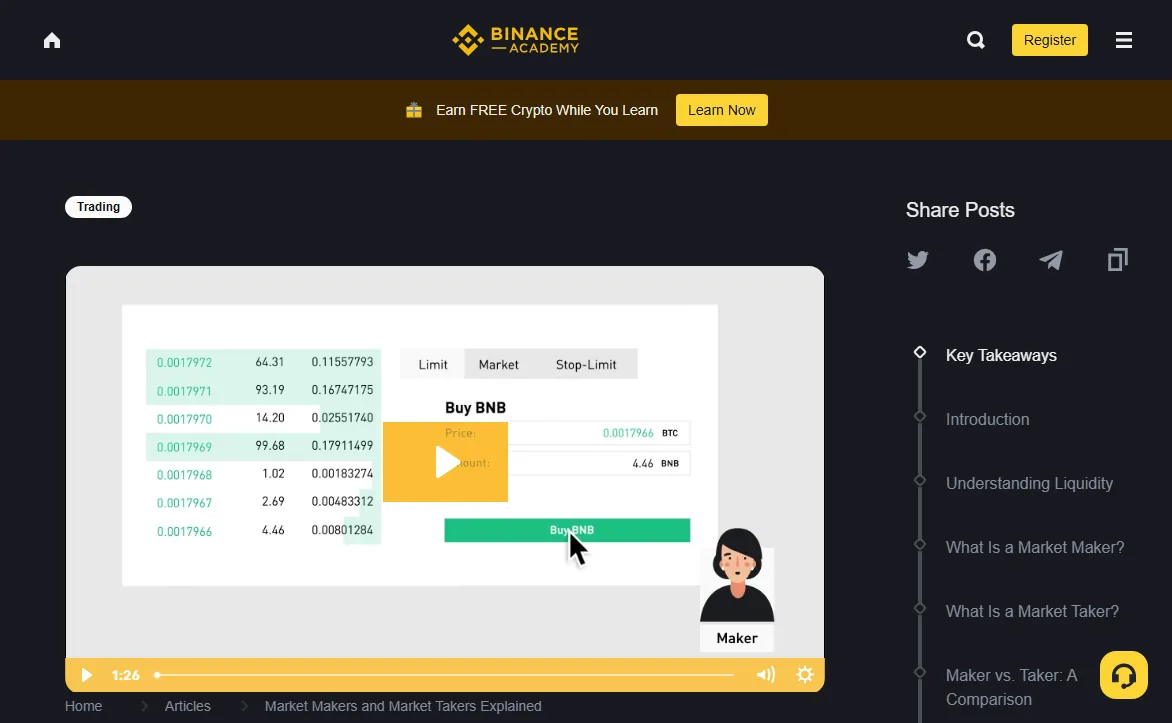
A single order can also be both, and the fee splits accordingly. A limit buy at 100 for a quantity larger than what is resting at 100 will consume everything available, pay the taker rate on that portion, and leave the remainder resting on the book as a maker order for later. The trade history shows the two portions separately, with different fee rates against the same order.
That split is usually where people first notice the distinction is real. One order, one click, two lines in the history at two prices and two rates. Nothing has gone wrong. The order simply did two different things. For the background on limit orders generally, Investopedia's entry is a clean reference.
Resting orders are the product
Exchanges charge makers less because resting orders are the thing they are actually selling, and the fee schedule pays people to supply them. A book with depth on both sides gives everyone tighter spreads and less slippage, which attracts more volume. Charging makers less pays for that depth. Charging takers more collects it back from the side consuming it.
An exchange with a thin book is a bad exchange. Spreads are wide, a modest order moves the price against itself, and traders go elsewhere. An exchange with a deep book has tight spreads and small slippage, which brings volume, which brings more depth. The whole thing is a loop that has to be started and kept running, and charging makers less is how that is done. It is a subsidy to the people whose orders create the depth, funded by the people consuming it. On some venues the maker fee goes negative at the top tiers, meaning the exchange pays a rebate for adding liquidity. That is not generosity. It is buying inventory for the shop window.
Understanding this also tells you something about your own trading. If you are habitually a taker, you are habitually paying the higher rate and also paying the spread, and on a thin book you are paying slippage on top of both. Those three costs stack and only one of them appears in the fee column.
What does a post-only order do?
Post-only cancels the order instead of executing it if it would take liquidity, which pins you to the maker rate and says nothing at all about whether you get filled.
It is a safety catch. You attach it to a limit order and the exchange checks, at the moment of submission, whether the order would cross the spread and execute immediately. If it would, the order is rejected or cancelled rather than filled. If it would not, it rests on the book as normal.
What it is good for:
- Locking in the maker rate. Useful when you are on a tier where the maker and taker rates genuinely differ and the difference matters at your size.
- Protecting against a moving price. You calculated a resting price against a book that has since moved. Without post-only, your order arrives and fills immediately at a price you did not intend. With it, the order simply does not happen.
- Systematic quoting. Anything running automatically, where an accidental crossing order repeated hundreds of times is a real cost.
The cost is straightforward and it is not small: you may get no fill at all. Post-only converts a certainty into a maybe. If the market runs away from your price, the order is cancelled and you are left holding an intention rather than a position. On a fast move that is the difference between being in the trade and watching it.
So is it worth switching post-only on to capture the maker fee? At the regular-user level on Binance, checked on 2026-08-30, maker and taker are both 0.100% on standard spot pairs, so the answer is no: there is no fee to capture. It becomes worth using once you are on a tier where the maker rate is genuinely lower, or where what you want is a hard assurance that an order will never cross the spread, whatever it costs you in missed fills. Those are two different reasons and only the second one applies to most accounts.
There is a fiddly failure case too. Submit a post-only order at exactly the top of the book and it may be rejected because, in the fraction of a second between your click and the matching engine seeing it, the book moved and your price became crossable. Nothing is broken. The catch did its job. But if you are placing orders one at a time by hand, expect the occasional silent rejection and check that the order actually landed.
At the entry level, the maker rate saves nothing
At the entry level on Binance, nothing at all: checked against their published fee schedule on 2026-08-30, a regular user pays 0.100% maker and 0.100% taker on standard spot pairs.
This is the honest and slightly counterintuitive part, and it is worth stating plainly because a lot of writing about maker fees skips it. The distinction that the whole of this article has been explaining does not save an ordinary retail account a single cent on those pairs. The two rates are identical until you climb the volume tiers.
| Level | 30d volume | BNB held | Maker | Taker |
|---|---|---|---|---|
| Regular User | < 1,000,000 USD | ≥ 0 | 0.100% | 0.100% |
| VIP 1 | ≥ 1,000,000 USD | ≥ 5 BNB | 0.090% | 0.100% |
| VIP 2 | ≥ 5,000,000 USD | ≥ 25 BNB | 0.080% | 0.100% |
| VIP 3 | ≥ 20,000,000 USD | ≥ 100 BNB | 0.040% | 0.060% |
Read the gap between the two rate columns as you go down. It is zero at Regular User, one basis point at VIP 1, two at VIP 2, and two at VIP 3 against a much lower base. So the maker discount is real, and it only starts existing at a million dollars of thirty-day volume, which is a threshold most accounts will never approach.
On the same 2026-08-30 reading, a 25% discount applied on spot when fees were paid in BNB, bringing the regular rate to 0.07500% on both sides. That reduction is available to everyone and is worth more to a small account than anything in the maker column. USDC pairs showed a separate and lower schedule on the same date. All of these figures move, so treat the published fee schedule as the authority and this table as a snapshot of one day.
The practical conclusion for a small account: choose your order type for execution reasons, not fee reasons. There is no fee to save. The breakdown of where the money actually goes puts spot trading fees in context against the costs that are genuinely larger.
Certainty of execution against cost
Taking liquidity buys you an immediate fill at a price you do not know in advance; making liquidity buys you a price you set exactly, with no assurance of ever being filled.
Strip away the fee schedule and that sentence is the whole decision. Every order type is a position on that axis.
| Order | Will it fill? | At what price? | Fee side |
|---|---|---|---|
| Market | Immediately, against whatever is there | Unknown until it fills | Taker |
| Limit across the spread | Immediately | Your limit price or better | Taker |
| Limit resting on the book | Only if the price comes to you | Exactly your price | Maker |
| Post-only limit | Only if it rests; cancelled if it would cross | Exactly your price | Maker, enforced |
Which one is right depends on why you are trading, not on the fee. If you need to be out of a position now, take liquidity and pay for it. If you have a price in mind and no deadline, rest an order and let the market come to you. If you are placing a large order into a market that is not deep, breaking it up and resting the pieces is usually cheaper than any fee consideration, because the cost you are avoiding is slippage rather than a rate.
I have watched people put real effort into shaving a basis point off the fee while sending market orders into a book that could not absorb them. The fee column is the small number. The fill price is the large one.
If you want to know which side you were actually on, the trade history will tell you. Each fill is listed with its own fee, and on most interfaces with a maker or taker label attached. Look at a week of your own fills before deciding you are a maker. Plenty of people who think of themselves as patient limit-order traders find that most of their volume went through as taker fills, because the orders they place are priced to fill now rather than to wait.
One caveat on scope. Everything above describes spot trading. Derivatives run on a separate fee schedule with its own tiers and its own maker and taker rates, and the two are not interchangeable. If you trade both, check them separately.